EYFS · Ages 4–5
Reception.
Julia Donaldson Class & John Bond Class. A gentle, phased start to school life — with plenty of play, outdoor learning, story-time and lots of chatting.
The team
Who's looking after them.
Each of our Reception classes is named after a much-loved children's author. Two parallel classes share one Reception team — children move between them for play, lunch, garden time, and story-time. Our Reception teaching assistants are Miss Wozniak and Miss Sturgeon. They work across the Reception classes rather than in one class, so they can go where they are needed.
EYFS · Reception
Julia Donaldson Class
Miss Finley
Class teacher · Mrs Phillippo teaches on Friday mornings
EYFS · Reception
John Bond Class
Miss Earl
Class teacher, Monday to Thursday · Mr Johnson teaches on Fridays
Curriculum
What they're learning, this year.
Reception's year follows the Early Years Foundation Stage curriculum across seven areas of learning. The half-termly topics give the work a focus — books, themes, trips — but the underlying skills (phonics, number sense, communication) build steadily across the whole year.
The year at a glance
Autumn 1
Marvellous Me & Once Upon a Rhyme
Autumn 2
Celebrations
Spring 1
Wild Things
Spring 2
We're All Superheroes
Summer 1
Amazing Animals
Summer 2
On the Move
Reception long-term overview 2026/27
Autumn 2 · this half term
Celebrations around the world.
Autumn 2 · Celebrations
We explore celebrations and festivals, starting with the ones in our own families, such as birthdays and Christmas. We learn that people have different beliefs and celebrate special times in different ways, and that some places are special to people in our community. We also watch the seasons and weather change, and compose our own lyrics and actions for a song.
In phonics we carry on with the Stage 1 Song of Sounds, blending sounds and reading words with familiar letters. We talk about stories, predict what will happen next and use different voices for the characters. In maths we compare sets using “more than” and “fewer than” and focus on the “fiveness of 5”. Each week both classes visit the school library to choose a book to take home.
Coming up: our Reception Nativity on Wednesday 2 December.
Autumn 2 topic web: Celebrations Autumn 1 topic web: Marvellous Me and Once Upon a Rhyme Autumn term letter to parents
By the end of Reception
What success looks like.
The Early Years Foundation Stage Framework sets out what we work towards across the seven areas of learning. A child who reaches the expected level in the Prime Areas plus Literacy and Mathematics has an overall ‘good level of development’ — the EYFS marker we report on at the end of the year. Every child develops at their own pace; these are the milestones, not a checklist.
Communication & language
Listen carefully in a range of situations, follow instructions involving several steps, and answer ‘how’ and ‘why’ questions about stories and their own experiences.
Personal, social & emotional
Play co-operatively, take turns, talk about their feelings and others’, and form positive relationships with adults and other children. Confident to try new things.
Literacy — reading & writing
Read simple sentences using the phonics they’ve learned. Form most letters correctly, write their own name, and have a go at writing simple sentences.
Mathematics
Count reliably to twenty, place numbers in order, and use everyday language to talk about size, weight, capacity, distance, time and money — through play and practical activities.
Want the full Early Learning Goals across all seven areas?
What we're reading in class
Books we love right now.
“Reading is one of the very best ways to support your child’s learning across all areas. Just a little every day increases their vocabulary, enhances their understanding of the world and develops their comprehension.”
— the Reception team
Our key texts
Reading is at the centre of all of our learning. These are the key books we’re sharing with the children right now.
Supporting learning at home
How you can help.
A handful of ways to back up what we're doing in class — phonics, handwriting, number sense, and reading. None of these need to be long; little and often beats a big session at the wrong moment.
Phonics
We work on our stage 1 song and concentrate on digraphs and trigraphs — where two or three letters together represent one sound, e.g. ch, igh, air. We’re also building children’s confidence to recognise tricky words on sight, and the skills to blend (putting sounds together) when reading, and segment (breaking sounds up) when writing.
Here’s the Stage 1 song the children sing each day — you can sing along at home too.
Below is a quick guide to how to pronounce each sound — useful to watch through together at home.
Handwriting & letter formation
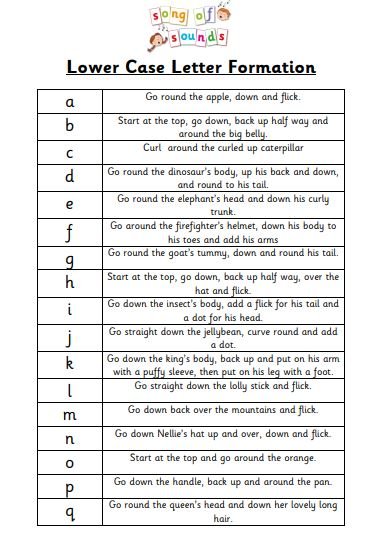
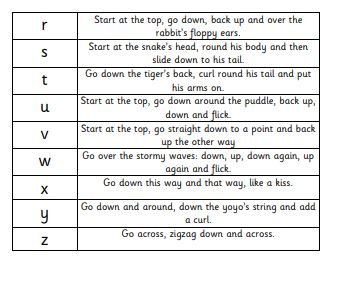
During our phonics sessions, we will begin to look at correct formation for each letter. We encourage children to use the correct formation starting from the right place — see below.
The Song of Sounds formation ditties help children remember the shape and sequence of each letter.
Number sense
Counting reliably, recognising numbers, ordering them, and using everyday language for size, weight and time — through play, songs and practical activities throughout the day.
Reading at home
Children bring home a reading book matched to their phonic level — one that doesn’t challenge them, so they can build confidence and fluency to segment and blend. The books include some of the ‘tricky words’ we’ve learnt.
A few minutes a day is enough
- Choose a convenient time — for many children 5–10 minutes is plenty.
- Use the pictures and characters to draw your child in.
- Give plenty of praise.
- Stop if they’re bored or losing interest.
- Use the reading record to note down comments — we love hearing how they’re getting on!
Things to talk about together
- What they enjoyed (or didn’t) about the book, and why.
- Any comparisons to other stories or to their own life.
- Comments on what happens in the story.
- Ideas for what could happen next.
- Things they notice in the pictures.
Just for Reception parents
Things only you need to know.
The bits and pieces that are different for Reception — kit, drop-off, lunches, what to bring, what to leave at home. Plus the year-specific moments to look out for: the phased start in September, the nativity, sports day in summer.
Drop-off & pick-up
Reception children come in from 8.40am, ready for an 8.50am start, and the day finishes at 3.10pm. Parents can use either gate, and the Reception team stand at the classroom gates to meet and greet the children.
PE kit
PE is on a Wednesday. Children come to school in their PE kit that day, with ear tape over pierced ears and long hair tied up. Please label all kit.
Snack & lunch
A free piece of fruit or veg is provided at morning break. If you send a snack instead, please keep it to fruit, veg or cheese — and remember we are a nut-free school. Lunch is a free hot meal from FEED (ordered on the FEED app so the kitchen knows numbers), or a packed lunch from home. See School lunches for details.
Visits before you start
In the summer term, the Reception team visits children at their nursery or pre-school. Then in September there's a staggered start, so everyone settles in.
Phased start & nativity
Children start in two groups by birthday: mornings only (8.40am to 11.45am) for the first three days, then two days until 12.45pm including lunch, and full time from the second Wednesday. Before that, in the summer term, there's a teddy bears' picnic, a transition morning when children visit their new classes, and a parent welcome meeting. Around October there's a phonics and reading meeting for parents. The Reception Nativity is on Wednesday 2 December in the school hall.
What to send in
A named book bag with their reading book, reading record and library book, every day. A water bottle, a spare set of clothes and a coat that can get muddy. Wellies in winter.
Questions before September?
Contact the school office to arrange a visit at a time that suits you — we're happy to help.